
Breakthrough robotic microbots open new possibilities in medicine and manufacturing
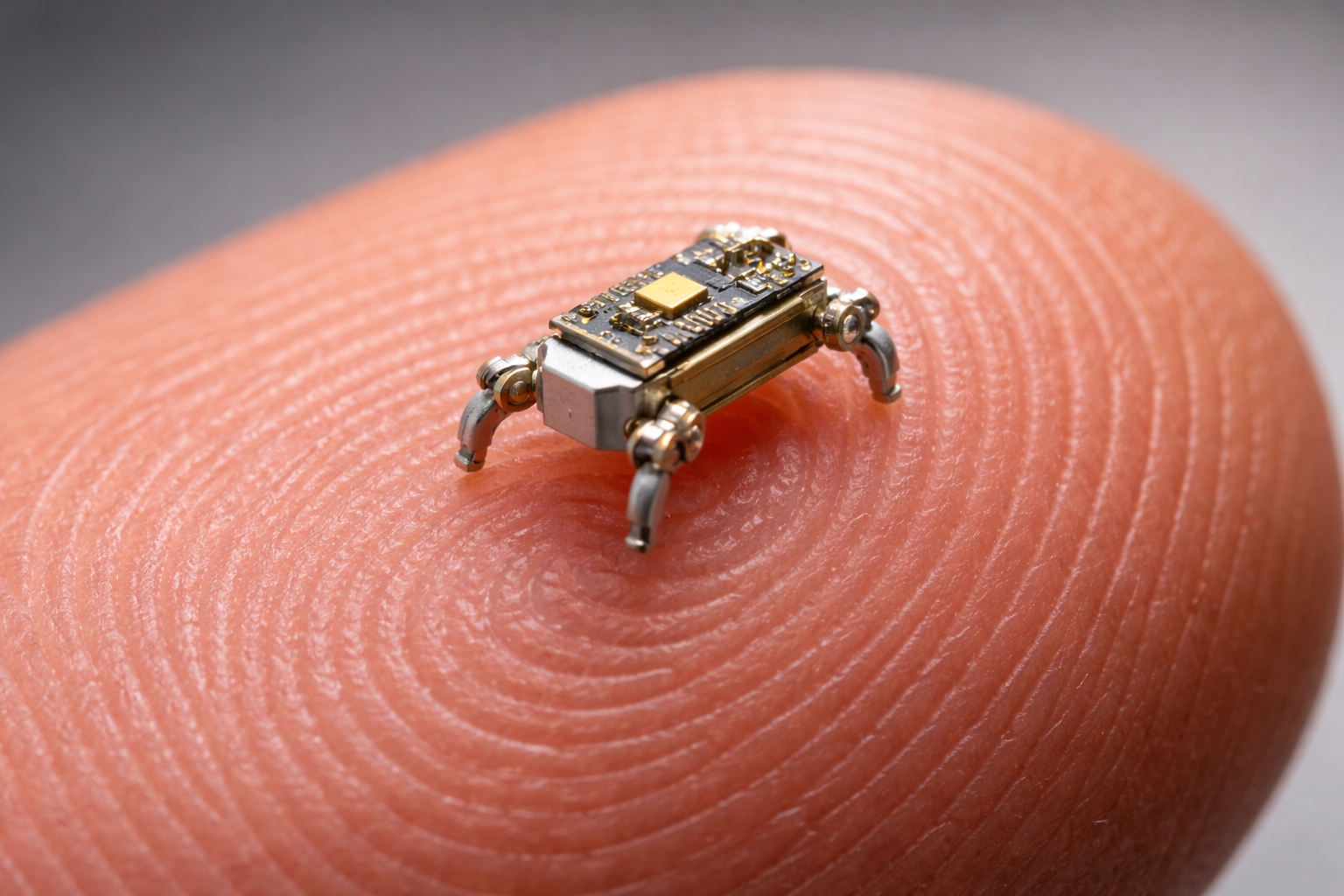
Researchers at the University of Pennsylvania, in collaboration with the University of Michigan, have created the world’s smallest fully programmable, autonomous robots. These microscopic swimming machines can sense their environment, make decisions and carry out complex tasks independently, marking a major leap forward in robotics research.
Tiny robots meet big scientific challenges
Microrobots robots measured in micrometers have long been a tantalising goal in science. These tiny machines promise to transform fields ranging from healthcare to micro-manufacturing. But until now, very few autonomous microrobots could both think and act on their own, especially at scales smaller than many biological cells. The new development combines ultra-efficient computing with innovative locomotion to overcome decades of barriers.
How the microbots are designed and what they can do
The newly developed robots measure roughly 0.2 by 0.3 by 0.05 millimetres, smaller than a grain of salt, yet pack a full suite of sensors, processors and actuators that let them behave autonomously.
Here’s what makes them remarkable:
- Fully programmable and autonomous: Each microbot contains a tiny onboard computer that processes information and directs behaviour without external control.
- Light-powered operation: Solar cells on the bots harvest light energy, powering both computation and movement with just 75 nanowatts about 100,000 times less power than a smartwatch.
- Unique locomotion method: Instead of traditional motors, the robots generate an electrical field that nudges ions in the surrounding fluid to push water, effectively making the robot “swim.”
- Sensory capabilities: They can detect temperature changes with precision and adjust movement accordingly, allowing them to navigate toward or away from stimuli.
- Light-based programming: Light pulses both power and program the robots, and each one has a unique address for individual tasking, meaning groups of bots can perform different roles simultaneously.
These features together make the microrobots not just mobile, but capable of independent sensing, reasoning and response a first at this scale.
A milestone of microelectronics and robotics
Professor Marc Miskin of Penn Engineering describes the achievement as “an entirely new scale for programmable robots,” noting that combining propulsion with onboard intelligence had eluded researchers for decades.
University of Michigan engineers played a key role in miniaturising the computing elements, designing circuits that operate at extremely low power. These innovations build on years of research in sub-millimetre electronics and ultra-efficient processors.
Beyond robotics hype
This breakthrough isn’t just about making smaller machines; it’s about expanding what robots can do at scales humans can’t reach. Because these bots are autonomous and programmable:
- They could one day monitor the health of individual cells inside living organisms.
- Scientists may use them to construct or repair microscopic devices that modern manufacturing struggles to handle.
- The technology could help researchers understand biological processes at the cellular level in ways previously impossible.
The ability to operate for months independently and in watery environments similar to those inside the human body could have profound implications for precision medicine, diagnostics and micro-scale fabrication.
What’s Next: Future developments and applications
Researchers are already exploring ways to add more sensors, increase speed, and program more complex behaviours. Future versions might:
- Store larger programs for broader decision-making
- Integrate additional environmental sensors
- Coordinate as swarms for sophisticated group tasks
- Operate in more challenging biological or industrial environments
Experts believe that as microelectronic fabrication advances, these robots could become even smaller, more capable, and cheaper to produce potentially enabling mass deployment in scientific and medical settings.
A new frontier in microrobotics
The debut of these fully programmable autonomous microbots marks a pivotal moment in both robotics and microscale engineering. By blending tiny computers, sensors and innovative propulsion, the research teams at Penn and Michigan have opened doors to technologies once deemed science fiction. As these robots evolve, they could reshape industries from healthcare to manufacturing, bringing a future where microscopic machines work alongside humans in everyday science and medicine.